
The tool is designed to detect whether a given URL is phishing (malicious) or legitimate, using neural network models. It analyzes the URL string itself without relying on external services or manual feature engineering.
Purpose
Phishing attacks often use fake URLs that look similar to trusted websites. The goal of this tool is to:
- Automatically classify URLs as phishing or legitimate
- Reduce user exposure to malicious links
- Provide reliable detection in real-world environments
How the Tool Works
1- Input
The system takes only the raw URL text as input. It does not depend on webpage content, domain registration data, or third-party lookups.
2- Model Types
The study compares two neural network approaches:
Deterministic Model
- Produces a direct classification (phishing or legitimate).
- Outputs a single prediction score.
Probabilistic Model
- Produces a classification.
- Also provides a confidence estimate.
- Helps assess how certain the system is about its prediction
The probabilistic model adds reliability by identifying uncertain cases.
Training Data
The models were trained using:
- Public phishing datasets such as PhishTank
- Public feeds like OpenPhish
- Private real-world data from EasyDMARC
The dataset included hundreds of thousands of URLs, both phishing and legitimate.
Performance
Key findings from testing:
- Accuracy between 95% and 97% on unseen data.
- Strong performance on both short and long URLs.
- The probabilistic model improved reliability by providing confidence ranges.
- The system remained effective when deployed in production settings.
Deployment
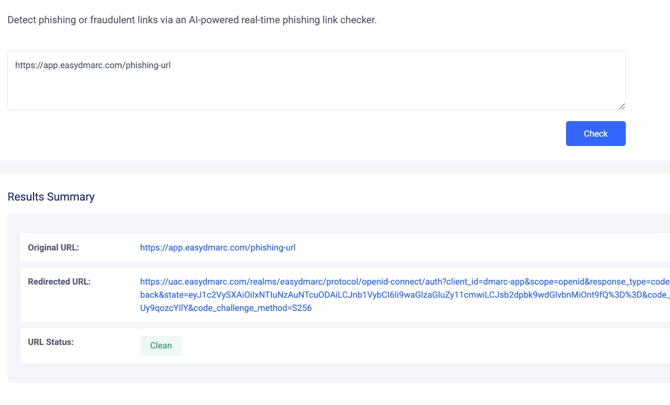
The phishing URL checker was implemented in a real-world environment through EasyDMARC. This shows the tool is not only theoretical but practical and usable at scale.
Users can submit a URL and receive:
- A phishing or legitimate classification
- A probability/confidence score (in the probabilistic version)
Key Features
- Uses only URL text
- No manual rule-based feature extraction
- High accuracy
- Production-ready deployment
- Confidence scoring (probabilistic model)
In case you want further information, you can check the full article here.
If you experience any limitations, do not hesitate to open a support ticket using this link. Our support team will gladly assist you.